
Original Screenplay
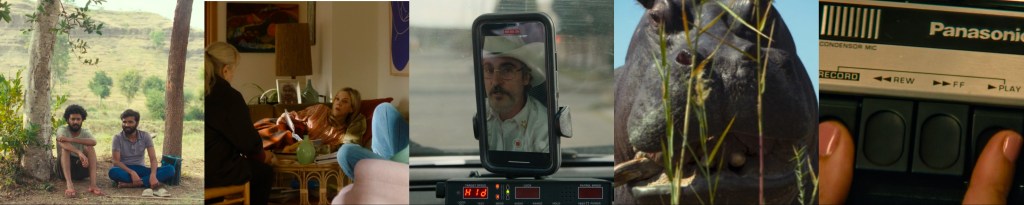
- Cactus Pears, Rohan Kanawade – The intricacy of Indian mourning rituals is not something I came into the film with prior knowledge of, yet the gossamer ease and depth of Kanawade’s presentation makes this wholly accessible, at no cost to specificity. Cactus Pears announces its emotionally sharp, novelistically dense, elegiacally paced approach from the jump, starting at the shoulder of a lonely, touch-starved gay man thrust back into the traditional culture of his ancestral village after his father’s death. He returns with his mother, finding a family openly curious about his longstanding bachelordom and wondering whether his being single should limit his role in the funeral proceedings. A childhood friend interrupts his grieving with the potential of new connections, of love and affection Anand has long denied himself. Cactus Pears braids these threads together beautifully while strengthening each cord on its own merit, continuously layering key relationships and dynamics. The framing of its rural/urban divide, the pressing obligations to family and self, religion and sexuality, give each side real depth without simplifying into easy binaries. But they are forks in the road, presented so conspicuously Anand must reckon with the choices he’s been making all his life and the one he must make right now.
- Dreams, Dan Johan Haugerud – Each entry in Haugerud’s Dreams/Sex/Love trilogy boasts exemplary writing. Observations of human behavior driven by romantic, sexual, and personal exploration, filtered through well-spoken, intelligent characters realizing how well they actually know themselves and their loved ones, are very much my jam. Dreams getting this slot is a bit of favoritism, yet I’m amazed how this script nimbly explores the perspectives of three generations of women while staying firmly rooted in the voice of its young protagonist. The earnest exploration of a student-teacher relationship that could be so troublingly disruptive to the whole project, both in terms of what actually happened and how it’s presented, is instead a marvelous feat of dexterity. The same can be said for the different forms of obligation and protection that daughter, mother, and grandmother feel towards a manuscript on that relationship. Haugerud’s inventiveness with structure and POV build beautifully and only grow more rewarding as Dreams progresses. It’s a fabulous study of love, of studying someone you care about so deeply it reveals more about you than it does them and learning how to carry the revelation with you.
- Eddington, Ari Aster – A national study astutely tuned in to the frequency of America’s current path towards self-immolation. Hindsight is 2020, sure, but few films have captured White America’s immediate, ferocious, even indiscriminate need to believe in something, whether they plan to stand by this cause or vilify it utterly. This is especially true if the person in question has zero skin in the game anyways. The mercenary opinions everyone in Eddington has about George Floyd is an obvious example, as well as an avenue to question if Eddington has much to say about anti-Black racism except that white people do it a lot. But this takes up so much oxygen, while the lurking data center actually ruining everything gets to watch the chaos unfold. I am also thinking of Deirdre O’Connell’s merry recruitment of a group of “truth tellers” who speak against powerful people for grooming minors, only for her to shut this topic down as soon as her adult daughter has something to say about the husband/dad they lost seven years ago. Everyone wants to fight the boogeyman without having to check if he’s under their own bed. It’s a trenchant critique, made stronger through impeccably constructed sequences, and with a much surer hold on mordant, increasingly surreal comedy than what Aster attempted in Beau is Afraid.
- Pepe, Nelson Carlos de los Santos Arias – What a strange, witty essay. Literally every element of this script could signal the demise of a less assured film; if a different viewer wants to say they were bored or overwhelmed by the ethnographic surveys of multiple countries, the petty human foibles, or the dives into hippopotamus culture scattered throughout, so be it. But as individual gambits and as a single, ambitious script, I thought Pepe managed these elements beautifully, without making them any less alienating. Best of all is the plummy, existentialist narration of the hippo from beyond the grave, who’s an inspired entry point into this bizarre history. Much like how Dahomey imagines a point of view for its handful of returned artifacts, Pepe gives this unfairly slain animal a cosmic grasp on the forces behind its fate. This even includes the illogic of human behavior. Why any of this happened is a mystery, and no amount of omniscience overrides Pepe’s animal instincts or Pablo Escobar’s monstrous vanity.
- The Secret Agent, Kleber Mendonça Filho – Mendonça continues to craft singularly wily, politically ripe, unmistakably living tales of Brazil and its people. Provocations like a dead body rotting unclaimed for days outside a gas station or a cat with two faces manage to feel folded into the everyday fabric of this world at no loss to their uniqueness. If the mid-film interview between Armando and a federal agent crystallizes The Secret Agent’s calico narrative, the compounding jump to an unseen party listening in on the conversation is similarly miraculous at expanding and clarifying its thematic ambitions. Where the macabre, genre-blending inflections continue to grow in Mendonça’s libidinous, culturally rich scripts, he also achieves a historical and cinematic resonance that feels just as revolutionary. Bonus points for the long, silly story of the severed leg kicking its way through town, continuing a storied tradition from Brazilian journalists who used a science-fictional leg as a placeholder to get around censorships forced by the dictatorship.
The most honorable of Honorable Mentions belong to: Twinless, one of the year’s most entertainingly thorny character studies, a marvelous depiction of co-dependency and obsession in a caustic comedic key – some structural hedged bets in the last third kept it just outside this list, but the best stuff has lingered tremendously. Souleymane’s Story features some incredibly precise plotting within a street-realist milieu designed to make its script unnoticeable, yet the braided threads of Souleymane’s journey and the corker of a finale they lead to are astonishing without once asking for attention. It turned out I really was taking Grand Tour’s screenplay for granted in my Fifties post – the romantic longing and ethnographic odyssey are so intricately constructed, not just a foundation for the exquisite direction but a thematically rich text on its own. If I Had Legs I’d Kick You is a marvel of controlled entropy, propelling Linda through a theatrically heightened, darkly comic, but very recognizable shitshow of maternal, medical, and psychic anxieties. Eephus is far more relaxed in its philosophical queries about life and fulfillment but just as insightful in its own way, and just as funny. These five made the closest plays for my lineup, and I’ll be thinking about them just as much as the films I selected. Behind them but still worth celebrating are: The sinewy, serpentine plotting and suspicious histories of Ghost Trail; the Kafkaesque pile-on of haters converging in Cloud; Roofman’s assured assembly of a story and character template easy to take for granted; Familiar Touch’s prismatic study of a woman fading before our eyes and the folks trying to take care of her; the strong start and nasty stinger of It Was Just An Accident; Marty Supreme’s understanding of myopic opportunism, stitched tightly to a guy who will say and do literally anything, and inviting us to wonder what it’s worth; the razor-sharp interactions and surprising digressions of Sentimental Value, though I have questions about how the two major supporting roles were portioned throughout; the covalent strands of resistance, uprising, and suppression in The Alabama Solution; All That’s Left of You, which braids melodramatic gestures to real-world tragedies fairly well, and makes its anger, sorrow, and hope equally powerful; and On Becoming a Guinea Fowl, which unfolds its layers of complicity and familial strife as a slow boil revealing just how high the temperature’s been for a long, long time. Let’s also give a group shout-out to Sound of Falling, Sirat, Blue Sun Palace, and The Testament of Ann Lee, all films with such immaculate direction I worry I’m underestimating their scripts.
Adapted Screenplay

- Die My Love, Lynn Ramsay, Alice Birch, and Enda Walsh – Firstly, it’s always nice to see Alice Birch and Enda Walsh named in the credits for any screenplay. Those are two writers who know how to make ambitious stories of inward-facing characters translate before the camera, and Lynn Ramsay’s own penchant for inchoate yet robustly expressive protagonists undergoing journeys only they could take makes them ideal collaborators for her vision. I adore how the script functions as a parable of marital and maternal grief, charting a course of one woman’s unraveling without taking many conventional routes to stage and structure it. Grace’s bonds with her husband and his parents are reflective and insinuating, digging so deep that her most combustive actions are contextualized as far more than simple histrionics. Yet I also love how bratty she is, how her anger mainly manifests through impulsive and outrageous behavior. Inserting a wedding that feels like a crumbling flashback, with no preamble, is an audacious gamble, as are the trips to an institution choreographed like Grace is stuck in a temporal loop. While the maybe-imagined affair is not an aspect I find as thematically rich as those connections, it fractures Die My Love’s formal strategies in exciting ways, and I have no notes for how anyone handles that dog. The film-long catalogue of compounding pressures on Grace’s post-partum depression, from the isolation of provincial living and the stifled artistic ambitions, without reducing her ordeal to any one pathologizing motive, is quite heroic.
- The Naked Gun, Dan Gregor, Doug Mand, and Akiva Schaffer – I see the critiques arguing The Naked Gun redux has not sufficiently updated the ZAZ deadpan spoof for the modern era. Sure, this style of comedy is clearly foundational to these writers, but set pieces like the satanic snowman threesome feel distinct to this era of stupid, surreal ingenuity. The skewering of so much contemporary discourse – evil tech billionaires trying to take over the world, white male fragility, police malfeasance, the persona its leading man has been cultivating for over fifteen years – are very appreciated, and kick a little harder than you might expect. They slot in perfectly with the more timeless riffing on hard-boiled noir tropes, and it gives the actors lots of room to play with their roles. But the heart of the matter is The Naked Gun is the funniest, most jam-packed gag session of a big-studio script I’ve laughed through in God knows how fucking long. All these themes are packed boldly into the jokes, as proudly lowbrow and expertly crafted as the News Years Eve Balls. The film-long gags and unexpected reprises (“Papa?”) are just as hysterical and pay off just as beautifully as the ridiculous one-offs and big setpieces. There’s some self-erasing as it goes, all the better to move on to the next insane bit, but as a trade-off for the kind of unyielding joke-making momentum that could win a girl the Kentucky Derby, that’s more than fair.
- One Battle After Another, Paul Thomas Anderson – From my review, with some additions: “I still pine for a longer, thornier conversation between Willa and Deandra, which is the one thing I think this version of OBAA is actively missing. But otherwise I’m so impressed with how sprawling PTA’s vision is across characters and eras while still granting so much room for generosity, ambiguity, and audience speculation. At every step, this script is rich in detail on character and country. The collective portrait of the people who engage in underground activism is magnificent, depicting a movement in terms of the people on the ground actually doing the work, in whatever way possible. It’s exciting without always editorializing on “right” and “wrong”, and always in the context of humanized behavior. By contrast, the Christmas Adventurers and the various fascist police forces register as a singular malignancy of whiteness, all the more noxious, threatening, and mind-numbingly stupid for operating as a hivemind.”
- Pillion, Harry Lighton – A BDSM comedy of manners, exploring the ways kink can be used as a pathway to self-actualization or a shield against genuine intimacy, depending on how you use it. Lighton streamlines some of the thorniest dynamics present in of Ray’s seduction of Colin, making their earliest, nonverbal sexual encounters a lucky and clearly consensual meeting between a willful, overeager sub and commanding, assumptive dom. Yet even this gets retroactively reframed across Pillion’s exploration of what a person wants and needs for themselves in a relationship. What starts off as risky and exploratory might not remain fulfilling, yet this would be impossible to want or articulate without that initial leap of faith. Interjections from supporting characters are pointed and thoughtfully articulated, without closing any of the windows for individual and emotional interpretation Pillion has maintained so marvelously. The whole thing is assuredly pro-kink, making Pillion the rare romance where a nubile hottie ends up very happy with the new culture he’s part of. Lighton’s deft balance of eroticism, humor, companionship, and true intimacy is heroically and creatively written, without ever signaling how hard he’s working or how tricky the text is, yet it’s so assuredly rich you have to marvel at it.
- Preparation for the Next Life, Martyna Majok – As with Cactus Pears, there’s an immediate value to Preparation so adeptly showcasing cultures and experiences rarely captured on film. It’s one thing to fill a representational void, another altogether to do justice to the people being depicted. So yes, I’m psyched to see a major independent film about a young Uyghur Muslim woman who immigrated to the US, situated in a larger Uyghur community, living and working in New York’s Chinatown. It’s certainly rarer than stories of a young white US army man coming home lost and displaced, though those stories aren’t automatically better-treated. To see Majok and director Bing Liu adapt this timely character study with such guts and tenderness is a tremendous feat. Watching Aishe and Skinner (played deftly by Sebiye Behtiyar and Fred Hechinger) challenge each other to a push-up contest is a fantastic, utterly unique meet-cute, allowing them to competitively size each other up while proving their ability to take care of themselves. Preparation continues to find unconventional ways to explore its characters, circumventing some familiar migrant cinema tropes just as often as it plays others with unpretentious directness. Through all of this, Majok’s script balances a documentary-style immersion with melodramatic narrative movements, making this very timely story feel totally real.
Honorable Mentions go to three films: Peter Hujar’s Day proved itself to be a nifty experiment in “real-time” conversation, approximating the slow drip of friendly chatter while adding so many disruptions and ellipses that it becomes much more than merely restaging an interview; Hedda’s enormously ambitious reinterpretation of Ibsen, thoughtfully re-centering race and gender into this manipulative chamber drama; and The Chronology of Water, which eschews so many biopic templates to take an unusual, abstracted shape, a platform for Stewart’s audiovisual experiments that’s still legible on its own terms as a psychic transmission of Lidia’s tumultuous exploration of who she is. Hamnet and Train Dreams both lose points for carving down some of the thorniness inherent to their source materials, but they also capture insights and rhythms of lives spent immersed in nature and family, weighed down by grief. Further props to The Ballad of Suzanne Cesare’s insights and wit, cluttered as they are by its own structural conceits; the blending of essay and experimental structures in The Falling Sky; the mordant comedy and family melodrama inside the ornately orchestrated deaths of Final Destination: Bloodlines; Highest 2 Lowest’s uneven yet undeniable build in restaging Kurosawa’s classic; Kiss of the Spider Woman’s considerable ambitions with genre, politics, and romance, transposing the lead’s queer identities with such affection; the gutsiest propositions of No Other Choice amidst a structure I was never satisfied with; and Superman’s resurrection of Silver Age popcorn moralisms while being potently timely about who Superman is, what he stands for, and what it means for him to exist in this world.
Ensemble
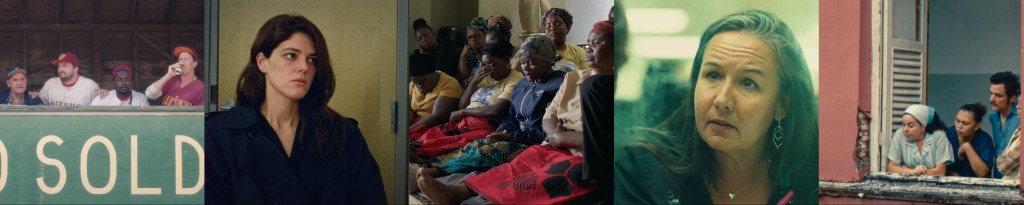
- Eephus, Carson Lund – A flawless constellation of masculine ennui, punctuated with humor, frustration, camaraderie, and emptiness. The structure of Eephus demands each character must immediately emerge onscreen with backstory we may or may not get to unpack, slotting themselves into a recognizable variation of American manliness without landing as cliches with no room for development. All of these people, whether they’re playing or spectating, must import distinct personality into their line readings and actions without taking up more space than they’re given. There’s no lead for this cast to orbit around, meaning each player also has to function as satellite and star while sweating, thinking, running, and joking like the star of their own Abbott & Costello number for the whole show. I’ve thought most about Keith William Richards, who has perhaps the biggest role of the four dozen bodies onscreen, and whose irritation with the big game he’s playing, The Big Game he’s stuck in, and his own unshakeable commitment to seeing it through is played perfectly. Russell Gannon’s bizarre asides and Joe Castiglione’s corduroy professionalism are just as instrumental to Eephus’s overall canvas. While I can’t say I remember the specific contributions or line readings of other cast members, the faces of Bill “Spaceman” Lee, John R Smith Jr, Brendan “Crash” Burt, Isabelle Charlot, and Nate Fisher have made a remarkably long-lasting impression on two viewings, and I imagine on rewatch I’ll react to their compatriots with great warmth and familiarity.
- Invention, Courtney Stephens – As a tone poem of irresolution and grief following the death of her father, co-writer/producer/star Callie Hernandez and director/writer Stephens have constructed an unusual venue to dramatize those feelings. Hernandez plays a barely-fictionalized version of herself opposite her dad’s actual colleagues, with close friends cast in key roles. Old videos of her conspiracy-minded father and footage (mostly audio) of the artists on set convening after Stephens wraps a scene are interjected between sequences that thrive as facsimiles of heart-to-heart disclosures. Invention has the air of a hermetically sealed eccentricity, made more intriguing by its metatextual inspiration runs and how often it punctures itself with interjections of its own creation. The cast sustains this poignantly grounded (un)reality, impressing themselves like watercolors dripping and swirling together across a canvas. Sahm McGlynn, Caveh Zahedi, Joe Swanberg, and Tony Torn add unique tones despite their interactions with Hernandez having similar trajectories. James N. Kienitz Wilkins is simply far more interesting than he has any right to be, as the executor of her father’s will, explaining patent law around the guy’s crackpot health inventions with a gentle but earnest investment in this woman. Hernandez, a watchful, patient observer pulling reservoirs from still waters, is mourning her father and dissecting but is even more unbalanced to learn how much of himself he kept from her. She’s as much an author of Invention as Stephens, yet she (like the film) is so generous with her attention as to make each character’s memories feel as essential as hers.
- On Becoming a Guinea Fowl, Isabella Odoffin – The cast of Nyoni’s parable are tasked with embodying a musculature of misogynistic social structures. Enablers, perpetrators, victims, and and truth-seekers must all emerge with some degree of individuality and history while fulfilling a larger commentary, and they do so with the kind of smoothness that you’d only imagine could come from huge families with decades of time to get to build these bonds. Shifts in temperature and tone are tangible, whether it’s within one actor’s performance or the ripple-effect of multiple players pushing with and against each other. As our entryway into this uniquely brave tale, Susan Chardy inhabits Nyoni’s wry, deadpan rage with remarkable control, transmitting from behind Shula’s locked-down expressions the uneasy truth of an abused young woman who has not received the luxury of building any space between herself and her armor against the world. Her curiosity at this conspiracy of silence is as palpable as her moral clarity. Elisabeth Chisela brings a welcome flamboyance as Shula’s alcoholic cousin, manufacturing real bravado through her drinking while still finding the pain behind Nsansa’s growing lucidity. Esther Singini, Norah Mwansa, Malita Mulenga have structural reasons to stand out, but they seize their different pleas for humanity with the same crisp, unblinking truth as Doris Naulapaw and Henry B.J. Phiri bring to their own declarations of family obligation and self-deception. The hordes of aunties, uncles, and cousins are too numerous to name in full, but their impressions are striking and concise in every composition possible.
- One Battle After Another, Cassandra Kulukundis – The year’s best assemblage of star power, buoyed by a gallery of vivid walk-ons with just as much screen charisma and evocative power as the marquee names. One Battle’s thesis on person-to-person interaction as the most integral building block of social activism is borne out through every figure we meet. It helps tremendously that PTA has directed them to such different performance styles. DiCaprio is as transparent in his ardor and helpless panic and Taylor is alluring and removed, both played in a naturalistic key. Penn’s obtuse physicality and Vince McMahon walk constitute the most stylized acting anywhere in the film, and these ridiculous affects come at no cost to the man’s dangerous, commited bigotry and smothered humanity. When Benicio del Toro arrives on the scene, his relaxed cool stands out amidst a frantic story and calico cast. Chase Infiniti’s watchful, physically robust star turn – mirrored overtly by her character’s coming of age as a new age revolutionary – is as hard-fought as Willa’s own journey for survival. Different degrees of audience familiarity with the likes of Alana Haim, April Grace, Junglepussy, Regina Hall, Tony Goldwyn, Jim Downey, and Teyana Taylor all serve the narrative like gangbusters, filling out the profile of key but minor roles. But in keeping with the theme of ordinary faces being just as important as the “noteworthy” figures, One Battle also boasts the most piquant collection of one-scene roles in maybe any film this year. I’ve thought about the heroism of Esperanza Rodarte de Santoyo and Hadasa Genesaret Palomares, the dynamic duo who spring Leo from the hospital, about as much as the starrier names above. The same goes for Carlos MacFarland’s Bluto and Willa’s other friends, and every face who has to stare down James Raterman’s insidious interrogator.
- The Secret Agent, Gabriel Domingues – Like Callie Hernandez and Susan Chardy above, Wagner Moura provides a valuable, grounding center to his film’s peculiar ambitions. He’s present, intelligent, elusive without being closed-off from scene partners, and sexy as a fuck under any and all circumstances. Maybe the best thing about Moura’s performance is how he provides such a porous center for The Secret Agent’s ragged, rambunctious energy. Mendonça has conducted his actors to bring their own distinct colors to the proceedings, and he deserves ample credit for weaving this ensemble into a cohesive whole while allowing for personalized stamps in every role. My thoughts go quickly to Alice Carvalho’s outraged turn in a mid-film flashback, and to Carlos Francisco’s pained but steadfast support as her grieving father. Gabriel Leone and Roney Villela are intimidating as a storied father-son hitman team, though Kaiony Venâncio’s taut, unpredictable gunman and Luciano Chirolli’s corrupt executive bring their own forms of danger, palpably informed by their rungs on a very tall totem pole. Tania Maria, an octogenarian actress making her cinematic debut, holds court with all the screen charisma of a Scorsesian elder statesman, and her boarders respond fully to her spritely energy while adding their own lively, intelligent textures. It’s the largest ensemble of my five nominees, and thanks to Domingues’s exceptional casting, literally every setting in The Secret Agent has enough human intrigue to suggest a universe all its own.
Extremely Honorable Mentions, in alphabetical order, belong to: The Dreams/Love/Sex trilogy, whose actors could fill an entire acting ballot off the strength of their preternatural chemistry alone, showing old bonds and new ideas with equal vivacity in face, body, and mind. The bevy of professionals in A House of Dynamite make the looming disaster credible and terrifying. Rose Byrne’s ferocious star turn in If I Had Legs I’d Kick You is all the more impressive for how the figures in her life emerge as heightened yet recognizable individuals. The ensemble of It Was Just An Accident do tremendous heavy lifting to ensure these characters register as human beings inside Panahi’s outraged national allegory. Love, Brooklyn, with its sensationally mature, sexy star turns from André Holland, Nicole Beharie, and DeWanda Skye, also boasts unusually three-dimensional turns from tertiary figures we only think we have pegged from the get-go. Roofman’s casting is inspired across the board, with its pitch-perfect central duet enriched in every way by the lived-in, sharply etched supporting players. The cast of Sorry Baby are as vibrant as a well-honed theatre troupe, piquantly connecting dots over the gaps of Eva Victor’s script, which thrives as discrete setpieces yet palpably needs its actor’s insights to pull it all together. Close behind these films are the central odd couple of The Baltimorons and the folks who comprise their baggage; Bring Her Back and Final Destination: Bloodlines for giving human stakes to their horror stories; the vivid gallery of faces in Marty Supreme; the comedic versatility within an iffy script in One of Them Days; the insanely high batting average to Sisterhood’s collection of first-time teenage performers; the warring couples of Splitsville, elevated by the kids, lovers, coworkers, and helpless bystanders pulled into their orbit; and the multi-dimensional duet between O’Brien and Sweeney in Twinless, punctuated by well-cast and smartly used supporting players.
Leading Performance
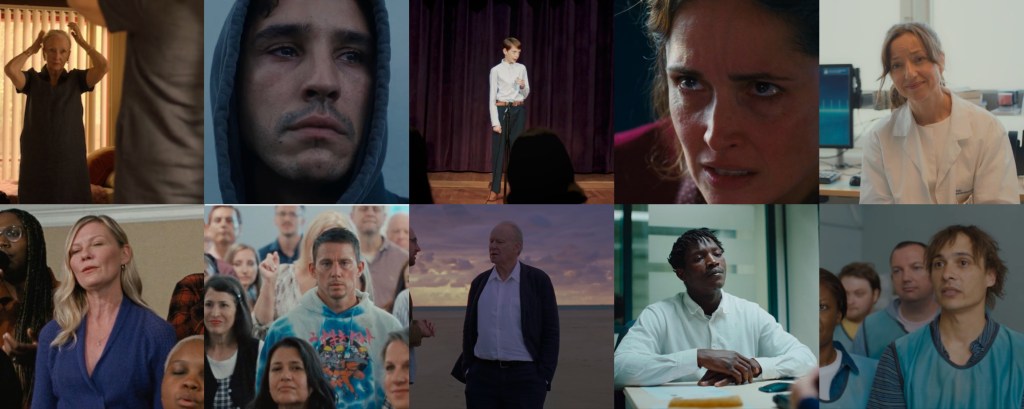
- Familiar Touch, Kathleen Chalfant – From my review here: “She’s utterly synchronized to Friedland’s ambitious presentation of mental decline and scattered personhood within a fairly sharp woman, as well as the cinematic grammars Familiar Touch uses to forward our understanding of Ruth. Chalfant’s physical carriage from scene to scene, the way she holds her head or looks someone in the eye, is just magnificent, communicating as much as her line readings about how Ruth sees herself or wants to be seen by others at any given moment. I love how she enters a kitchen she’s never been in as though she’s worked the line for years, or the absolute serenity she communicates floating in a pool, quietly asking for another minute to float. Chalfant and Friedland never once present dementia as blank-faced docility or cheap hysterics. Instead, they show us Ruth as a prismatic array of personality traits, life experience, coping mechanisms, and reflexive behaviors. Even as she rotates amongst selves or grasps at her reality with slippery hands, Chalfant ensures Ruth is engaged with her surroundings and responsive to others. She’s not always inhabiting the same truth as her caregivers, but that’s not the same as being disconnected from them. Chalfant’s baseline of emotional legibility and psychological opacity could not be better-tailored to what Familiar Touch needs, and I can’t imagine it without her bravery and insight.”
- Ghost Trail, Adam Bessa – Within Ghost Trail’s layered story of a Syrian refugee in France seeking vengeance against a man who may have been his torturer or a fellow collaborator, there’s room for writer/director Jonathan Millet’s arenas of tension to become lurid, illegible, or overwrought in ways that betray the character’s journey and the audience’s intelligence. Millet’s muscular compositions avoid these pitfalls, but even more impressively, lead actor Adam Bessa maintains an astonishing tightrope of elusiveness and legibility. He’s remote to the camera’s gaze without ever becoming inaccessible or colorless. Nor does he become a limited scene partner to his costars, finding new angles of candor and deception with each new character. Hamid’s actions and Bessa’s playing of them are vivid in the moment and potent in retrospect, meaning Ghost Trail’s provocations are never reducible to empty shocks. Our sense of Hamid’s goals shifts the more we learn, but Bessa always conveys an agent actively in mourning for himself and his people, still trying to decide what justice means, how it might weigh on his soul long after this mission is completed. More than that, he must also read as a migrant trying to get his footing in a new country, a man comforting his mother without lying to her completely, an educator looking for an outlet to further his craft. Bessa aces the everyday human textures as gracefully as the genre-specific, close to the chest tensions that are Ghost Trail’s marquee attentions.
- Griffin in Summer, Everett Blunck – Griffin is maybe the least lode-bearing film represented anywhere on this ballot, with its perfectly solid formal construction, very funny comedic instincts, and heartstring-pulling gestures it mostly gets away with. You’ve simply never seen a young boy’s actressexuality brought to the big screen like this, and Blunck’s star-is-born turn brings this whole enterprise to life. I simply can’t imagine how an actor could nail the scene of Griffin performing a scene from his own play – a high-octane, alcohol-fueled marital shouting match over life experiences he seemingly only knows from Tennessee Williams plays – without the subsequent performance honoring the sincere bravery for this openly gay middle schooler to put himself out there like this, while still recognizing what a demented thing this is to present with such confidence. Blunck’s underplaying of moments where Griffin internalizes some familial discord keep the script from pushing the idea of his plays being a wayward coping mechanism too hard, instead letting that possibility float alongside questions of whether the boy will grow into the artistic talents and interpersonal skills he needs. As great as he is with the dramatic beats, he’s even better with the rich supply of comedic notes and the deer-in-headlights approach to his crush on Owen Teague’s poolboy. Blunck has found a way to inhabit Griffin’s theatricality, his obtuse insistence on his own art, and the sensitive nature of a tween who thinks he knows everything, only to repeatedly reckon with how wrong he is, in ways that are comedic without making the boy himself a walking caricature. A small miracle, utterly distinct from Blunck’s more acclaimed, equally vivid spin on teenage isolation and fractured self-confidence in The Plague.
- If I Had Legs I’d Kick You, Rose Byrne – From my review here: “Byrne’s ability to make Linda’s implosive behavior so empathic is an insanely difficult feat. It’d be so easy to make Linda into a one-dimensional creation, yet she and Bronstein are heroically committed to presenting recognizable human experiences within a destabilizing tone. Her moments of quiet tranquility are well-earned, her slide into helpless desperation inevitable and legible at every step. I’m amazed Byrne is able to thrive inside Bronstein’s claustrophobic frame while still connecting fully to her unseen daughter and her scene partners. To steal a very vivid description from my friend Robert, her eyes are so expressive they feel like extra mouths.” A rewatch of If I Had Legs made me further appreciate the humanity Byrne has imparted in Linda’s self-fulfilling prophecy of abject failure, at absolutely no cost to her venom and exhaustion. The way she simply doesn’t have time for the husband of a missing client is priceless, as are her repeated spats with a bitchy motel clerk. Linda’s total, troubling certainty in her repudiation of a support group for mothers of persistently ill children is tremendous, a howl of despair buoyed by how much she’s been left to manage by herself that’s been fucked seemingly beyond her control. The sheer messiness of her dynamic with her therapist colleague is astonishing, over-reliant but earnest in her need for support. You believe Linda when she says she doesn’t know what to do, yet Byrne makes this utterance more complicated for the slantwise truth to it, hiding a more terrifying fear: What if she knows what to do and it isn’t enough? It’s a harrowing scenario for any one person to face, and Byrne negotiates all of this with dexterous aplomb.
- Love, Andrea Bræin Hovig – Amidst all the exemplary acting in Dag Haugerud’s Dreams/Sex/Love trilogy, Hovig’s debut performance remains my crown jewel of this trio. As a 40-something doctor who’s decided to explore previously untested philosophies towards romance and sex, Hovig’s Marianne projects the full-bodied sensuality and lambent, crackling interiority one expects from an Eric Rohmer protagonist. She connects fully to her conversation partners, layering gradations of attention, disinterest, longing, or that polite silence of waiting for the other person to finish talking so she can say her piece, without ever being an overly-active listener. It’s rare to see an actor so fully convey inattention without seeming unresponsive to her co-stars, yet Hovig fully weaves this detail into her portrait of a woman, fulfilled in certain avenues of her life, taking several leaps towards a new version of herself with openness and curiosity. I love watching Marianne negotiate how much she wants to commit to a new lover, and whether the young daughter and unhappy ex-wife still in his life are a real issue or convenient excuse. Her rapport with a gay coworker going on a similar journey of exploration is a great, companionable relationship, even before it’s solidified as the spine of the whole film. Hovig anchors Love beautifully in every shot, giving Haugerud’s unexpected inquiries the loose, warm, intellectual and erotic center they deserve.
- Roofman, Kirsten Dunst – No, I will not quibble with anyone who categorizes her as supporting – I only moved her up to lead in February – but I think her centrality to Roofman and her luminous performance more than compensates for arriving about 40 minutes into the film. As my friends Patrick and Claudio said, Dunst would more likely be seen as a lead if this exact structure was used in a ’40s Jean Arthur vehicle. Dunst’s personable, heavy-lidded lucidity is a great baseline for a single mom working a crummy customer service job. Her sunniness is immediate and credible, as are the different degrees to which she tolerates insolence at home and work. Leigh’s relationships with her daughters, her church, and her coworkers instantly translate onscreen as storied and credible bonds, without much explicit backstory in the script. Dunst makes this bedrock feel so real, which only makes the newness and excitement of her connection with Jeffrey all the more lovely to behold. Through her, we also think about the material, economic repercussions of Jeffrey’s actions long before he does, cutting through his self-idealized views without becoming a drag to the film. Does Leigh notice her lowered hours when he edits her schedule for more family time, and does this impact her pay enough to inform her financial anxiety? How will Jeffrey’s crimes impact her standing in the community? What is she thinking about when her expression is so distant in the choir? Dunst makes you consider the contours of Leigh’s life far beyond what’s shown onscreen, enriching Roofman with as much creativity as any master bank robber.
- Roofman, Channing Tatum – Sure, we can distill (or dismiss) Tatum’s interpretation of Jeffrey Manchester as part of an existing repertoire of seemingly laid-back men of semi-dubious morality whose sphincters are locked tight with tension. We know, in the purest Golden Age Hollywood way, he has it in his bones to play this character. While the perfection of his casting is less mold-breaking than some of his co-stars, it’s still impressive how full Tatum refashions his compassion, smarts, and star power. I have no idea what inspired him and Cianfrance to depict Jeffrey’s combination of technical intelligence and blinkered interpersonal skills as high-functioning autism, but he stands comfortably alongside Paper Moon’s Addie Loggins in the pantheon of scam-artists and robbers whose understanding of family obligation is informed by their criminal talents. Tatum wears Jeffrey’s watchfulness as comfortably as a well-worn pair of jeans, or as easily as those cute glasses of his. I love his gentlemanly showmanship with the church women at their luncheon, and the scene is made so much better for how palpably he’s able to signal shifts in his bravado without letting the mask drop. His chemistry with Dunst is practically molecular, and every step of their journey together is played with the fresh, unvarnished honesty of two adults who know they’re finally too old for the nonsense they’ve been dealing with, and are looking for someone special to make things easy. Watching Jeffrey slowly realize the romantic filter he’s put on his actions, and the true impact of his criminal activity, is deeply moving and never once overplayed.
- Sentimental Value, Stellan Skarsgård – We love seeing a ubiquitous, renowned character actor getting a too-rare chance to headline a film and tear into it with gusto. Skarsgård’s ability to project different affects in his voice, eyes, face, and body language are pristine and dexterous, teasing different possibilities in Gustav’s relationships rather than pinning the man down even when the script offers a road for him to stick to. In his loyalty to an actress who seems obviously miscast for his upcoming film, his different paeans or repudiations of family, and his willingness to acknowledge his own mortality, these routes are all more flavorful and less predictable for the way Skarsgård muddies our sense of an arc progressing so much as centering the man’s ability to be honest with himself and his loved ones. Or does he realize he’s withholding as much back even as his loved ones seem to suss him out? You can see why his family and artistic collaborators (two categories with plenty of overlap) are so frustrated by him. In sync with Trier and Sentimental Value’s other artists, Skarsgård communicates the immense journey required for Gustav to begin making amends with his daughters, knowing full well there’s a whole lot of work ahead for this man and this family waiting for them after the movie ends.
- Souleymane’s Story, Abou Sangare – From my review here: “Sangaré contributes a feat of moment-to-moment physical legibility and carefully gauged expressiveness which singlehandedly justifies Boris Lojkine’s Dardennes-esque street realism. He must blend in with dozens of other delivery men in crowd shots while still communicating gears turning in Souleymane’s head, planning for his next assignment or worrying about one of the many obstacles waiting in his immediate future. There’s little time for retrospection, only the urgency to make enough money, pay off this alleged ally, rehearse “his” story in his head over and over. The way his entire body locks down when confronted by cops trying to extort a free meal is just as poignant as a scene of him video chatting with his sister, his face only lit only by his phone. Everything Sangaré does in his asylum interview (with great support from Nina Meurisse) is among the year’s very best acting, as he releases all of the fraught personal history he’s been told to suppress. It’s an emotionally walloping culmination of a performance heretofore defined by balancing withholding and transparency.”
- Urchin, Frank Dillane – From my review here: “Dillane gives an extroverted, mannered performance, rooted in an empathetic understanding of Mike’s decision-making and needs. He never showboats at the cost of cast members, instead showing himself to be a receptive, active scene partner. Dillane finds a man who isn’t particularly malicious even when he uses others. At no point does this character stand in for any social issue or personality type, even as the film posits his story as a parable of how an individual’s recovery and downfall are informed by the support they receive.” To add to this, the element of Dillane’s performance that lingered longest with me is the degree of self-awareness he gives Mike, even when his reactions are inappropriate. Mike’s realization that no, he did not consider what would happen to a man he violently mugged after he hit him, is dramatized with such an earnest, reflective close-up from Dillane. The revelation is all the more tantalizing for how abruptly the scene ends. There’s also a late scene where Mike harshly cuts off a friend who’s dancing around why she won’t let him move in with her. He simply doesn’t have time for her prevaricating – there’s no hard feelings to why she can’t risk hiding him, but her attitude bothers him. It’s a great, foundational approach to Dillane’s performance, one that makes the character and the film resonate that much harder.
To start off from an uncharacteristically gendered angle, we’ll kick things off with the likeliest candidate for my theoretical fifth Best Actress slot: Nina Hoss in Hedda, who makes Eileen Loveborg such an intellectual and erotic force that we understand how she’s both a worthy opponent to her paramour, yet doomed to the woman’s thrall, fresh and full of surprises even as every step sends her deeper into the spider’s web. Jann Gunnar Røise very nearly made his way onto this list for Sex, coming in hot with a nonchalant confession of potentially life-shattering nature only to be taken aback by everyone else’s responses, so sure of his identity and so thoughtful when challenged. Joaquin Phoenix in Eddington ups his game from his prior collaboration with Ari Aster, making his character’s small-mindedness, shame and desperation all the more impactful (and bleakly funny) for playing him at a life-sized, resolutely human scale. Jessie Buckley is so perfectly cast in Hamnet I wonder if I’ve underrated her work, but she’s tremendous. Jennifer Lawrence in Die My Love reaches a new peak in her full-bodied commitment to singular auteurs, her physical expressiveness and rough-edged emotionality an ideal partner for Ramsay’s oblique stylizations. Just as potent in his searching grief is Sergi Lopez in Sirât, whose total attention to his son, tentative community with the ravers, and variations on dogged determination and fatalistic despair are so poignant. Harry Melling and Alexander Skarsgård are a fantastic duet in Pillion – the former’s openness and gradual recognition of his own desires is so moving, and the latter’s tight withholding gives way to some fantastic breaks in the last half hour; both are sublime, and their tonal dexterity and physical commitment is very appreciated. Dylan O’Brien in Twinless gives my favorite of this year’s many dual-role performances, so assured in his body language and demeanor, embodying a bullish, unhappy man of great sensitivity as smoothly as his debonair, self-absorbed other half. Wu Ke-xi in Blue Sun Palace pulls a similar coup as Taylor Russell did in Waves, emerging beautifully from a tertiary figure to a grief-stricken center trying to find new meaning in her life – and Lee Kang-sheng is quitely astonishing on his own journey of loss and displacement. Denzel Washington is again tremendous with Spike Lee in Highest 2 Lowest, emerging as the most assured, surprising artist of the first half and still leveling his game up with the rest of the film in the second hour. Tim Robinson spins his persona of violently awkward but often well-meaning comedy in Friendship, generating a very strange pity as he torches his own life. Lastly, two more exemplary duets: Liz Larsen and Michael Strassner in The Baltimorons, who provide the semi-improvisational warmth and humanity so many other folks got out of The Holdovers, showing us two everyday folks pushing and supporting each other through one long, long Christmas Eve; and Sebiye Behtiyar and Fred Heichinger in Preparation for the Next Life, who play every beat of their unexpected romance and struggles to stay above water with muscularity and integrity.
Supporting Performance
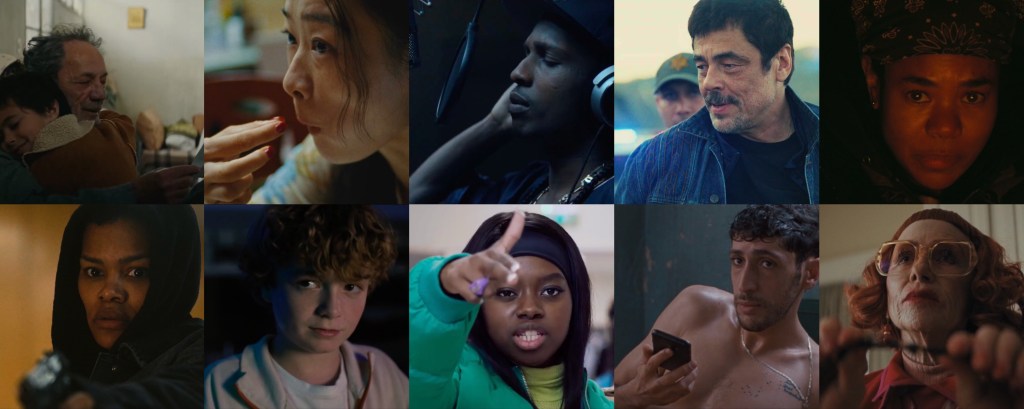
- All That’s Left of You, Mohammed Bakri – I have not seen any of Bakri’s prior films, meaning my awareness of his cultural legacy in Palestine came with no firsthand experience when I finally saw his final film role. So when I say he’s doing something hot-wired and outraged in All That’s Left of You, it’s entirely on the basis of this performance, which should convince me to see more of his work. As the older version of a patriarch who negotiated a peace treaty with Israeli military forces, only for them to force him off his family’s land and continue terrorizing his country, Bakri embodies a wounded, prideful hurt, recriminatory of his own loss and further disappointed no one has yet rectified his generation’s failure by exiling these colonizers. At no point are his pains flattened to purely rhetorical concerns. In Bakri’s walk, his often combative line readings, his utter fondness for his grandson and dismissiveness towards the boy’s parents, he hotwires this melodrama into a deeply personal point of view, all the better to help it reverberate with national scope.
- Blue Sun Palace, Haipeng Xu – Bless the Indie Spirits for nominating her, which made me look closer at this performance on rewatch. The structure of Blue Sun Palace ensures Didi lingers long after her final scene, but it’s an equal testament to what Haipeng Xu and Constance Tsang have achieved together. Right away we learn this woman is emphatically emotional, impulsive, and incredibly kind, yet Xu ensures Didi never becomes a paragon fated to be swatted down by a cruel film. Her rapports with Lee Kang-shen and Wu Ke-Xi are lived-in, receptive, and spontaneous. Arguably more interesting is how she reveals new, contradictory facets of Didi without resolving her to a single truth, labeling certain parts of herself as real or performative. In her gratuitous risk-taking at work, the ease with which she lies to her best friend, the unquestioning trust that sees her let a customer into the massage parlor after closing, Didi’s choices invite close scrutiny. Xu’s refusal of pathologizing or predictively tragic gestures, in sync with Tsang’s measured portraiture, give Didi’s actions a Marion Crane-style (il)legibility. She skillfully renders a three-dimensional woman, alleging total transparency while preserving secrets from her colleagues and her audience.
- Highest 2 Lowest, A$AP Rocky – From my review here, with some modifications: “A$AP Rocky responds to the narrative weight of his role by projecting a taunting, bullish arrogance, entirely opposite to Tsutomu Yamazaki’s steely control and piercing breakdown in the corresponding role from High and Low. The actor, carrying as much cultural caché in his version of Black stardom as Spike Lee and Denzel Washington do, is prismatic and engrossing in his two showcase scenes. Even before we see him in person, his phone calls puncture Lee’s uneven filmmaking with a brazen, disrespectful authority that’s darkly funny. Who’s this upstart trying to knock Denzel down a couple pegs? But God, his rapport helps Highest 2 Lowest achieve its most ambitious ideas. He seductively posits himself as the future of the music industry, benevolently offering David to join his upcoming rise and bluntly reframing his crimes as stepping stones soon to be outweighed by his inevitable success. A$AP acts as if he holds all the cards, daring the audience to wonder if he’s right, and giving David’s considerations of the man more weight than a lesser actor could have provided. It’s a great, controlled performance, one Highest 2 Lowest needed to stick the landing as well as it does.”
- One Battle After Another, Benicio del Toro – When Sergio St. Carlos tells you to take a deep breath, to pace yourself like an ocean wave, you listen. Maybe the best thing about del Toro’s performance is how he feels like the lead of his own film, rather than a supporting player facilitating Bob’s mission. He radiates a cool, no-nonsense ease in every aspect of his being, whether his mission is improving a teenager’s judo technique or leading an impromptu evacuation of the hundreds of migrants he’s safely rescued to his apartment building. There’s no pretense to his unflappable demeanor. He’s a relaxing, no-frills presence, which doesn’t mean he’s monotonously incapable of expressing impatience or cracking jokes. Sergio knows to do the right thing, and del Toro’s lack of bombast makes the clarity and heroism of his actions all the more commanding.
- One Battle After Another, Regina Hall – I just love looking at her face. Hall has shown herself to be one of our most preternaturally expressive working screen actors, and you can see this largely through how locked down she is throughout One Battle After Another. She’s maybe the only major character who doesn’t have a laugh line, and rather than imparting extraneous personality to fill the void, Hall honors the seriousness of Deandra’s mission with streamlined competence. The way Hall holds herself, the directness of her voice and the fullness of her attention, makes Deandra instantly plausible as a battle-tested revolutionary with deep conviction in her mission, imparting deep color to a profile with no history presented in the final cut. When she gazes at Perfidia, and later at Willa, we learn very little about what Deandra is thinking, yet the quality of Hall’s gaze is enough to make us sit up and take notice. Who is this woman? What, with all her experience, does she see in this child, this rescue operation, this leader? Hall doesn’t tell us much, but the mixture of purpose and withholding compels our attention completely.
- One Battle After Another, Teyana Taylor – An extraordinary performance, the most direct cinematic descendent of Vanessa Redgrave’s Julia I’ve ever seen. Taylor conveys Perfidia’s bone-deep conviction in her revolution, her savvy and intelligence in plotting tightly-coordinated missions. These elements sit comfortably alongside her unnecessary and giddy risk-taking, her self-disgust, the sheer panic when she knows a situation has escaped her control completely. Taylor’s physicality is a godsend, communicating so much about Perfidia’s fortitude through the way she holds her head or flutters her eyelashes. I love how she braids the character’s libido into her politics, showing us a woman who’s genuinely turned on by the world she’s constructing while making this dimension tangibly different from when she uses her body as a tool in her arsenal. No one part of this woman is inextricable from another, which makes Perfidia’s ambiguities as fascinating as her most definite traits. Taylor’s performance feels insulated from the most reductive summaries of who Perfidia is, yet her subtlety never closes off the ugliest motivators for her actions. Folding post-partum depression into guerilla warfare this subtly is tremendous, one of many indelible feats in one of the year’s most unforgettable performances.
- The Plague, Kayo Martin – In a year jam-packed with memorable antagonists, few felt as human-sized and discomfortingly plausible as Martin’s swim camp bully. For all the high stylization baked into The Plague’s direction, Martin doesn’t scale himself up to meet Polinger’s tone. Jake’s clearly having a great time at camp, yet even when commiserating with the homies he lurks with the impassivity of shark prowling for blood, looking for an opening to pounce with a well-placed jab or a question baited to lead his friends to further mockery. Sometimes he just lets his prey talk themselves further and further into a hole he won’t let them escape. Martin delivers his insults as an indiscriminate reflex, having honed his bullying instincts into a fine instrument. None of his cruelty feels rehearsed. There’s no sense of who he is outside of camp, no implied history to complicate or build towards one brief, potent glimpse of his home life. His attitude is so recognizable from boys I knew at summer camp, so quietly smug about his top dog status, but Martin ensures this kid is always legible as a barely-pubescent boy choosing repeatedly and happily to be a terrible, above-it-all little shit.
- Sisterhood, Medina Diarra – The charismatic standout of an ensemble jam-packed with teenage actors going above and beyond to deepen a somewhat schematic script. As Djeneba, one of the protagonist’s best friends, Diarra is unwavering in her confidence, her fun-loving exuberance, and her bullish intolerance for any disrespect. She’s incredibly real, never coming across as a stock figure in this contemporary morality play. When she warns the lead to keep her nose down, her anger is pragmatic, neither dismissive of Zineb’s pain or generous to Amina’s good intentions. Protecting herself and her friends from repercussions they can’t control in an already-dangerous neighbor is second nature. Diarra makes Djeneba’s joys and ambitions sincere where another actress might emphasize superfluousness, her humiliations palpable in ways that underline the fortitude she’s been wearing casually until then. It’s an incredible debut, one I hope leads to even greater opportunities in the future.
- To a Land Unknown, Aram Sabbah – The John Cazale to Mahmood Bakri’s Al Pacino. That line alone, applicable to their character’s dynamic and the quality of their performances, should be enough for folks to run towards this immigration thriller about two Palestinian cousins waylaid in Greece trying to scrounge up money for passports. Reda is prone to melancholy and susceptible to destructive tendencies, moving through the world with an openness his fellow immigrants have locked down to better survive. Sabbah, who’s arguably a co-lead in To a Land Unknown, inhabits this second-banana fuck up with distilled clarity in expression and carriage, legible to the audience without conflating delicacy for fragile, demonstrative behavior. He’s such a sweet, well-meaning man, lacking the self-control not to care for a child he’s recruited for a dangerous con, even as he’s aware this bond may have harsh consequences in the not-too-distant future. Sabbah never forsakes the autonomy behind Reda’s actions even at his most desperate, engendering sympathy without losing dimension to the pitiful, sometimes self-deluding justifications he professes. It’s such subtle, dexterous negotiation, offering so much detail whether sitting patiently on the sidelines or frantically shoved into the center of the action.
- Weapons, Amy Madigan – I still can’t believe Madigan’s trajectory from summer 2025’s instant pop-culture icon to critical darling to Best Supporting Actress Oscar winner actually happened. It’s miraculous for a genre performance by a 75 year old to earn such acclaim for any number of reasons, but it’s also wildly deserving on its own merits. Madigan’s flinty persona and utter lack of vanity make her inspired casting for this garish personality, and in tandem with her exemplary makeup and costume teams, she’s concocted a woman of equal parts severity and deliciously fruity affectations. I love how Aunt Gladys plays up the sloppiness of her disguise by acting so unapologetically bizarre. It’s a great ruse, performing gendered and ageist stereotypes in a sweetly scatterbrained register, compelling her prey to give her what she wants in the hope she simply goes away faster. She’s like a grotesque throwback to old-school flibbertigibbets, though Gladys’ darting eyes and fairly direct questions signal the mercilessly predatory interior she reveals when the mask drops. Madigan’s forthright attitude with Alex is maybe the most inspired move in a repertoire of unpredictable choices, regarding him with more maturity than she gives any adult, and ensuring the final chapter of Weapons registers as an actual battle of wills. At every turn, Madigan makes Weapons a funnier, more dangerous fairy tale, and I’m so happy she got her flowers for it.
Gender-neutral categories mean a fuckton of Honorable Mentions, so I’ll try not to go on for too long. First and foremost is Anne Marit Jacobson, whose patient, perceptive identification with her granddaughter is the thread of Dreams I was most surprised by on first watch, and who most captivated me when going back to it. Close behind her is Robert Pattinson’s highwire act of supporting spousing in Die My Love, who neither short-sells his character’s honest concerns nor softens the many ways he upsets and underserves his wife. I love everything Delroy Lindo does to make Delta Slim the slippery, storied heart of Sinners, crafting a man of many pains and many more pleasures, condensing the whole film’s ouroboros of music and religion in one grizzled line reading. Nina Meurisse in Souleymane’s Story, Thi Nga Nguyen in Viet & Nam, and Elizabeth Chisela in On Becoming a Guinea Fowl (aka the three supporting actresses from the Fifties who didn’t make this list) are all instrumental additions to their films, sketching their characters with precise detail and utter synchronicity to tough projects. Gwyneth Paltrow is Marty Supreme’s secret weapon, wielding her star persona beautifully and sympathetically in service of this sad, intelligent woman. Meanwhile, Jacobi Jupe is Hamnet’s not-so-secret weapon, refusing to lunge for undue pity, letting his condensed, undemonstrative pathos speak powerfully for itself. Celia Weston is so precisely humane in A Little Prayer, delivering one of the year’s most lived-in marriages with David Strathairn. Galaxies away, Oona Chaplin in Avatar: Fire and Ash reaps massive rewards by committing to this witch’s nihilistic, libidinous fantasies of cleansing fire. I’m open to arguments that Pamela Anderson in The Naked Gun is a lead, so long as we agree her talent for playing the femme fatale in sincere and loony gestures is undeniable. The alliterative duet of Suraaj Suman and Jayshri Jagtap provide essential work to Cactus Pears, humanizing and therefore deepening the film’s cultural study. Zarna Garg, Harish Patel, and Sunita Mani are even greater life rafts in A Nice Indian Boy, each one so moving and deftly funny it makes me grateful how the script affords them so much room to color their roles in the second half.
Cinematography
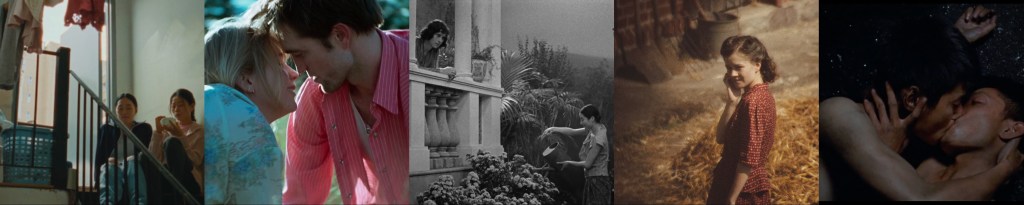
- Blue Sun Palace, Norm Li – Sometimes Blue Sun Palace registers as a series of still photographs cataloguing different forms of malaise, isolation, and happiness among New York City’s Chinese immigrant community, with artful attention to light and camera placement. Sometimes the camera is a roving, mobile force, a silent spectator of personal conversations and risky workplace interactions. Intimacy and remove are not just instilled in the characters but the audience. To use my own words from an earlier review: “Shot set-ups from hour one are weaponized when repeated in the second half. The camera itself is haunting the characters, whether it’s underlining the different trajectories of a massage therapist’s appointments or demonstrating how one woman is being asked, in all ways, to fill the void left by her dead friend. Norm Li’s cinematography is essential to realizing Tsang’s vision, in concert with a detailed sound mix and restrained editing patterns, giving each space a grounding texture while providing necessary inflections to help us better grasp the inchoate or inexpressible feelings each character is grappling with.”
- Die My Love, Seamus McGarvey – Manages an endless series of bold affectations while still retaining claims on subtlety and scene-specific inflections. The movement and placement of the camera, color palette, the hardness and saturation of light, shot duration, all of these elements fluctuate wildly not just between scenes but within them. I’m not always enraptured by this kind of florid hyperbole, which can feel suuffocatingly over-determined when handled improperly, yet I’m so awed by how Ramsay and McGarvey impart meaning in every shot, making vivid and immediate assertions about how Grace is experiencing her life. They find the exact visual meeting ground between the Catskills setting and the torrid Gothic atmosphere. Even when the camera is doing too much, it deserves respect for committing so fully to Ramsay’s heightened reality, bold but still subtle and affecting in traversing Grace’s red-hot, searching, sometimes inchoate, but rarely illegible point of view.
- Grand Tour, Guo Liang, Saymbahun Mukdeeprom, & Rui Pocas – I am forever amazed at how Gomes imbues his images with such cultural and thematic heft while presenting them as smooth and light as gossamer. Even as Grand Tour shifts kaleidoscopically between antique and cutting-edge techniques, documenting modern performances or deconstructing old-school genres, the cinematography retains an ephemeral quality befitting these seemingly disparate goals. The theater acts are spontaneous and kinetic, while the globe-trotting lovers are drenched in gorgeous, silvery photography even as they sprint further and further away from what they really want. Their melancholy overtakes Grand Tour’s visual language even at its most opulent. I’d love to know which parts of the film were shot by each of its three cinematographers, but the purposeful dissonances and affectations ensure Grand Tour’s wizardry is dense to behold and emotionally coherent to experience.
- Sound of Falling, Fabian Gamper – One of the year’s spookiest, most singular visions. When a film is called novelistic I tend to imagine it most reductively as being forward with dialogue and plot, keeping its visual strategies restrained in service of “the story”. You bet your ass I almost used it for Sentimental Value! But Sound of Falling’s camera is novelistic in a very different way, roaming between the physical and psychological perspectives of its many characters while always maintaining the camera’s role as an omniscient, restless eye. Even when Schilinski is sensorily immersing us in a subjective experience or physically inhabiting a child’s point of view, the restless, haunted cinematography ensures these striking moments cohere within its larger collage of oblique traumas. That’s a fucking elusive, disturbing portrait to make cohere! I’m amazed at how Gamper negotiates the morbid spirits haunting this family, which suffuse the house and its inhabitants differently in each era but must progressively overwhelm the audience. It does, while balancing the equally demanding task of allowing for quiet, singular inflections of curiosity, danger, suicidal ideation, and sexual intrigue, which must also echo throughout generations and characters in this byzantine structure. The bone-white slashes of sunlight and obsidian blacks are gorgeously complimented by the harsh, oxidized color palette. The tactility and depth of the images gives Sound of Falling the somber intimacy of a summer scrapbook where every picture taken is the last time the subject was seen alive.
- Viet & Nam, Son Doan – Tru’o’ng Ming Quy’s imagery (really his whole film) is weighed down by the historical and personal forces converging on his characters. There’s nothing offhanded about Son Doan’s photography, from camera placement to color saturation. Tru’o’ng’s palpable adoration for Apichatpong Weerasethakul’s cinema of lush environs and queer fascinations has grown organically into a tactile style all his own. There’s a self-conscious beauty to it, as well as an eye for visualizing unspoken tensions befitting the many secrets weighing on their hearts. Artful compositions and blocking of bodies give these inward-facing dilemmas a physical weight. And then there’s the sensual pleasures of giving these grimy, sweaty bodies the attention they deserve. The shot of Viet and Nam entwined in the mines, a cavern transformed into a galaxy, is one of the most memorable images in a year of movies and an apex of Doan’s creativity with black, dark photography. The same can be said for the men swimming across a river with body bags as floatation devices, mother and son being swept up in different hovels by the same tsunami, a crowd of miners in an elevator. It’s all so beautiful it aches, yet Doan never aestheticizes these tableaus at the cost of their humanity.
As always, this category is insanely crowded, and each runner-up would be a phenomenal winner in its own right. Still, Honorable Mentions belong to: Dong Jingong’s cinematography for Resurrection is chameleonically inventive and endlessly risky, across and within chapters. Sirât’s color palette and framing boldly accentuate the natural beauty and uncaring treacherousness of its southern Moroccan landscapes. Alex Ashe had two triumphs with The Ballad of Suzanne Cesaire and Peter Hujar’s Day, flexing immaculate control over light and shadow while flattering his casts and sets. The Chronology of Water tries out new palettes and compositions with as much bold, experimental ambition as Lidia takes in exploring her own identity. 2000 Meters to Andriiivka boasts unforgettable imagery, synthesizing an immediate and personal vantage that’s still legible as a heightened depiction of battlefield combat. Sentimental Value was in my lineup for a good while, and I look forward to seeing Tuxen’s skill with framing light and elevating performances develop further. Sister Midnight is a very close runner-up to Die My Love in the category of chromatically unpredictable and narratively rich achievements in lensing women on the verge of a nervous breakdown. Further but no less honorable mentions to April’s seasick wobbling and provocative camera placements, the in-the-moment kineticism of Souleymane’s Story, Baby’s seedy and lively lensing, the contrast of Malick-y natural majesty and digital sheen in Train Dreams, PTA’s trademark balance of personal stakes and panoramic scope in One Battle After Another, and the unsettlingly transportive imagery of The Ice Tower.
Editing
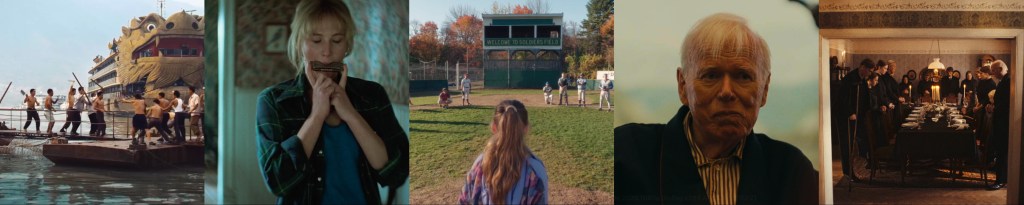
- Caught by the Tides, Lin Xuong, Matthieu Laclau, & Yang Chao – I’m not familiar enough with Jia Zhangke’s pre-Ash is Purest White oeuvre to fully imbibe the metatextual implications of the films he’s pulling from. Even with this caveat in place, I still recognize the poignancy of watching Zhao Tao and Lu Zhubin age over 25 years. The sentimental and ethnographic value of China’s landscapes shifting around them, as globalist economic developments and industrial evolution reshape the country, are not context for Zhao and Lu’s arcs (they never are in Jia’s films) but the subject of Caught by the Tides itself. The very DNA of Caught as an object of living histories and speculative futures resides in how it assembles this footage. I can imagine there’s many ways to Frankenstein Jia’s films that would’ve culminated as an affecting feature, but I’m amazed Jia and his team created this vision, with all the forthright joys, mysteries, and unspoken resonances it holds. Few films have lingered with me as potently as Caught has, and it comes down to the bold, serpentine way it slithers through these echoes, making them as tangible and present as anything happening “now”.
- Die My Love, Toni Froschhammer – The secret ingredient to Ramsay’s bravely controlled, jagged-edged chaos. Die My Love has to balance several highwire formal designs to editorialize Grace’s mental state while simultaneously providing a semblance of narrative trajectory for the audience to grasp onto. Without cleaning things up too much or losing the script to overwhelming style, and without becoming a self-conscious spectacle of its own, Froschhammer’s editing binds these elements together while remaining fully in Grace’s subjectivity. Immersing us in her headspace doesn’t make what we’re seeing more reliable for us or for her, and I love how the shape and temporal momentum of Die My Love endows whole chapters and characters with unique psychic reverberations. Does LaKeith Stanfield’s character exist, and does that automatically mean the affair is real? Why is the wedding weaved into the film with the floating, implacable sadness of a flashback? The cutting of individual scenes is electrifying and unpredictable, allowing sound, performance, and cinematography to retain their idiosyncrasies as a collision of sometimes-competing signals while still serving Ramsay’s vision.
- Eephus, Carson Lund – No American filmmaker wore as many hats as Carson Lund, the writer/director/casting director/composer of Eephus, as well as the man behind the film’s pristine editing. In concert with the loopy script and unpredictable dilations of time, the editing provides guardrails of focus and forward movement without tidying up its overall shape. Every scene feels equally major and minor as it unfolds, allowing for unpredictability and interruption to punctuate Eephus as much as the lazy-day impatience. The decision of when to cut between a group or medium shot, the interruption of shot-reverse shot close-ups of players psyching each other out with another body, holding on a conversation until just the right moment to make the joke or philosophical tangent stick the land, all of it are exemplary of editing patterns in service to a larger canvas without much interest in drawing attention to itself. Are the conversations between the many players and spectators digressions from the game itself, or is the game digressing from their discussions on life, the future, their obligations to their families? The savvy and wit of Lund’s editing keeps Eephus humming with minimal fuss, making its ideas and jokes richer.
- One Battle After Another, Andy Jurgensen – A tremendous feat of maintaining and modulating tension. The prologue alone is worth its weight in gold as compact, muscular storytelling, sprinting out the gate as fast as Perfidia. What’s just as impressive is how Jurgensen maintains this precision even when One Battle slows down for Bob and Willa to discuss the responsibilities and safeguards they owe each other before prom, or stops dead in its tracks for Lockjaw to snarl and huff while holding a steely young girl hostage. No matter the film’s tempo, Jurgenson’s editing is controlled and coherent. He’s a pro with the action sequences, constructing car chases and raids on immigrant camps more thrilling than your average tentpole IP. Characters are crystallized under the film’s roving eye, ensuring even the smallest roles are given real texture and presence when they might otherwise be reduced to just another body. Incidents are impeccably weaved together, letting the tension of simultaneous events feed into each other while pushing forward One Battle’s trajectory of careening danger. Vises are closed and escaped, legs are gnawed off, men waste time with codespeak and Santa Claus. The edit gives these elements their own tempos without losing a shred of detail, ensuring every inch of this canvas has color and personality.
- Sound of Falling, Evelyn Rack – I lost my mind upon learning the film’s insane structure, echoing and refracting across eras in ways that build implication without always making immediate sense, was more or less concocted by editor and director as filming was underway. Sound of Falling was written in chronological order and shot one generation at a time. Schilinski’s ambition for temporal scrambling and psychic reverberations was baked into the premise from the outset, but I can’t begin to imagine how anyone could have tunneled their way to this vision. Individual cuts, be they carving out a scene or transitioning from one era or interaction to another, imbue the film with tactile, spooky implications. The inscrutability of the early going is worth it for the challenges it places on its audience to match its indelible cinematic grammars, giving us the tools to dissect its connective tissues.
Again, what a fucking crowded category! Honorable Mentions: Few films unfold as hypnotically as Sirât, moving with purpose even at its most hopeless, equal deft with nail-biting tension and unexpectedly organic tenderness. The Mastermind’s cutting is drolly paced, punctuating the would-be heist with dead air and swerves neither the audience nor O’Connor’s criminal genius could predict. Grand Tour is light on its feet, even as it accommodates so many tonal and temporal intrusions. My Undesirable Friends Pt. 1 – Last Air in Moscow is slashed to smithereens, leaving almost no time for dead air when everyone’s already on pins and needles, an inversion to the lack of cutting within sequences in 2000 Meters to Andriivka, and through these strategies both documentaries find ideal pacing for their fireside camaraderie and desperate scrambles to stay alive. The Secret Agent’s editing is an ace accomplice to Mendonça’s sprawl without losing momentum or homogenizing the overall experience, allowing the jumble of tones, eras, and characters to emerge as a unified vision. I didn’t love everything about the style of My Father’s Shadow, but the editing balances personal, national, unapproachable, and intimate dynamics so potently. The braiding together concurrent actions and lord knows how many activists in The Alabama Solution is a tremendous feat, reflecting the group solidarity and profound isolation of its prisoners and their allies. Further Honorable Mentions to: Roofman sliding between genres with all the elegance Jeffrey Manchester imagines he has; the crashing, fevered montage in The Testament of Ann Lee; Leo Carax’s even more feverish montage and oddly poignant retrospection in It’s Not Me; the controlled pacing through good times and bad in Preparation for the Next Life; Souleymane’s Story and its rigorous workout of realist filmmaking designs; the immersive, jagged montage of The Chronology of Water; Splitsville and Final Destination: Bloodlines setting up and gleefully tearing down jenga towers of impeccable humor and ruinous decision-making; the dilations of time through stalking, confrontation, and internal reckonings in Ghost Trail; and to the impressive in-scene choreography needed to sustain the carefully timed edits in Afternoons of Solitude, Julie Keeps Quiet and To a Land Unknown, each an achievement across different genres.
Sound Design

- 2000 Meters to Andriivka, Jim Sullivan – So many aspects of 2000 Meters to Andriivka recalled Feras Fayyad’s The Cave as indelible records of wartime perseverance, but the most technically prodigious point of comparison is Sullivan’s sound mixing. The reconstruction, assembly, and cleaning up of all the battlefield combat is impressive by itself. Conversation and command between soldiers is audible from the subjective viewpoint of whoever we’re following into a firefight, meaning sometimes voices are drowned out and sometimes we hear a stand-off between enemy troops or a desperate, whispered prayer play out over bullet sprays and explosions. It’s so immersive in these sonic perspectives, while still very potent as on-the-ground reporting of individual and collective heroism in the face of such a perilous campaign. And while I agree Chernov didn’t necessarily need the low, moody strings underneath this sound mix to maintain the atmosphere of danger and exhaustion (much like The Cave didn’t need its more saccharine score), I think Sullivan wields it well to sustain this mood.
- Julie Keeps Quiet, Gustaf Berger, Boris Debackere & Matthias Hillegeer – While Julie remains a resolutely inward-facing character, the editing, cinematography, and performances align with director Leonardo Van Dijl’s careful balance of sympathy and remove. The audience is given room to contemplate the intent behind Julie’s silence while she reconciles her choices, yet her privacy is carefully preserved. Thus, the soundscape becomes our primary mode for interpreting her feelings. What can we learn from the buzz or chill of ambient noise, the force with which she hits a tennis ball during practice, the way prickly conversations are sometimes nearly swallowed by other sounds? Without once reaching for blunt effects or solipsistic absorption, and with no nondiegetic music to provide backup, we still intuit a lot about Julie through the precise sound mixing.
- The Naked Gun, Dan Kenyon – A shoo-in for Best Sound Editing, back when the art still existed. The silly, exaggerated sound work is key to the mix of hardboiled parody and straight up reliving the glory days of loud gunfights, brutal slap fights, and men getting their teeth knocked out only to have them kicked back into their gums with a sickening squelch. Lorne Balfe’s score keeps things humming nicely, and the overt riffing on Hans Zimmer’s many, many action movie themes is to die for. It’s the best kind of comedic gratuity, where even the smallest gesture is ripe for sonic nonsense, and the biggest, lumpiest showcases dwee bada dweet bada dweet along magnificently.
- Sirât, Laia Casanovas, Oriol Donat i Martos, Yasmina Praderas – Envelopes its audience in electronica and desert fury. Wrangling with Kangding Ray’s score is a feat in and of itself, letting the music overwhelm the film at the right times without losing control or flattening all other diegetic noises. Playing with the volume across giant parties or in private dwellings yields real character insights, along with assaulting the senses, though both goals are equally important. The yawning expanse of the mountains are foreboding to listen to, not due to menace but the total indifference a landscape this treacherous offers to all who dare to cross it. Moments of danger and tranquility are accommodated with real grace. There’s an immediacy to the sound mixing as well as a portentous sense of doom, giving the events we see the rumbling, terrestrial intensity of an unfolding apocalypse while fulfilling Laxe’s allegorical demands.
- Sound of Falling, Billie Mind, Jürgen Schulz, Kai Tebbel – If you didn’t know what falling sounds like, you do now!!! A movie called Sound of Falling couldn’t show its face in public without a vivid sound design, but that still can’t prepare us for what a unique, experimental strategy Schilinski’s team undertakes. As with the imagery and editing, the audio must serve as a violent, isolating affect and a connective thread braiding together characters and eras. Rustic, aquatic, and ghostly elements are mixed sensitively, ensuring our ears are always primed without overwhelming our senses to the point where Sound of Falling’s ambitious design accidentally cancels itself out. It feels like the whole world is drowning long before people start going into the water. As part of an indelible audiovisual approach but also as its own unique element, the sound design is crackling and alive, so real it transcends its own materiality into something alien.
Honorable Mentions: The precise variations in sonic intensity and smart soundtracking of Pillion is some of the best romcom mixing since Phantom Thread, dramatizing pleasure, nostalgia, and teasing boundary-pushing with a dab hand. More ferocious but no less detailed is If I Had Legs I’d Kick You, which stays keyed into Byrne’s fraying subjectivity, and makes the offscreen daughter so bravely unsympathetic. The Plague’s catalogue of early-00’s pop hits make its setting feel era-specific, and the overall mixing of water effects, swooning music cues, and subjective ephemera make its sound the most essential element of an already sturdy aesthetic strategy. Highest 2 Lowest boasts a fantastic soundtrack that only gets better as it progressively expands its catalogue of musical genres and cultural pulls. The needle drops in One Battle After Another verge on blunt overstatement where the score is slinky and counter-intuitive, but the insistence on making its ballistics so rough and loud is a bold refusal of glamorization without forgoing thriller tactility. The soundscapes of Afternoons of Solitude and The Falling Sky are hypnotically entrancing, immersing us in an unfamiliar environment and leaving us room to grasp complicated ideas without ever being fully accessible. Further honorable mentions to the vicious gore effects of Bring Her Back, The Testament of Ann Lee’s full-bodied musicality, the jukebox soundtracks of Grand Tour and Caught by the Tides, and Die My Love’s immersion into a teeming pastoral environment and troubled psyche.
Production Design

- Grand Tour, Thales Junqueira & Marcos Pedroso – Get ready for a lot of entries where I celebrate the blending of contemporary technique with callbacks to “doing things the old-fashioned way”, starting with the globe-trotting designs of Grand Tour. The recreations of British-controlled East Asia in 1917 are pristine, with every setting in the black-and-white narrative constructed on a soundstage. Each location is lush and detailed, suggestive of well-researched milieus rather than colonial fantasies, yet they also possess the lines, props, and structures used in movies from the 1910’s. She (Grand Tour) is feeling her fantasy, but as Gomes is wont to do, those fantasies are inescapably shaped by the world around them. Juxtaposing the soundstage sets with the locations as they currently exist makes their heightened verisimilitude even more impressive.
- Hamnet, Fiona Crombie & Alice Felton – What do you MEAN they BUILT the forest grove so central to several of Hamnet’s most intimate scenes? It’s such a perfectly constructed location I’d believed they just scoured it out in the wild. Hell, Crombie’s designs throughout are believable and eye-catching without looking fussed-over. Homes have the casual scuff that comes from generations of families living together under the same roof, while the clean lines of the architecture call back to theatrical spaces, incorporating prosceniums without becoming stagey. Color palettes, building materials, gardens, and personal objects communicate a lot about these characters. Sets accumulating detail and resonance as the makeup of the Shakespeare household changes. It all culminates at the Globe theater, which marries the natural and the domestic in Hamlet’s forest backdrop. What an evocative setting for Will and Agnes to wrestle with and expunge their grief. What a superbly crafted journey Crombie’s sets have made for them to get there.
- The Phoenician Scheme, Adam Stockhausen & Anna Pinnock – Unlike Marty Supreme or Sinners or Frankenstein, the immaculate sets of The Phoenician Scheme have the benefit of being lovingly attended to by its photography. Bruno Delbonnel visualizes Zsa-Zsa’s growing empathy for his fellow man by showing how the camera follows people through these doted-over environs, rather than making the actors into satellites or accessories for all the patterns, props, and pconstruction sites. This fetishization endows the film with an attentiveness towards its sets and museum pieces that’s never totally abated but always in service of human connection, befitting Anderson’s whole thing. The globe-trotting premise means a lot of unique locales with their own cultural currency, filtered through Stockhausen’s unparalleled ingenuity at turning Anderson’s dioramas (which are already livelier creations than they’re sometimes given credit for) into living, textured locations. And nothing in their prior outings prepares you for heaven.
- Resurrection, Liu Qiang and Tu Nan – Poses an incredibly difficult set of challenges for its production design team to realize. Each chapter has to have a distinct visual personality, without getting lost in its own extravagant ass (hi Poor Things). They must register as different eras, possessing their own reference points for cinematic stylization, color, and genre psychology, without succumbing to untethered pastiche. And they have to somehow cohere as a whole, without calling back to each other so overtly that the fantasy is lost. Liang nails these interconnected challenges to make the whole of Resurrection’s sets as vivid as each of its five parts. The exaggerated color stories and bizarre architectures of the frame story’s silent-era pastiche is as inventively designed as the austerity of the ruined Buddhist temple. Finding the right locations to make the material reality of the single-take love story feel as deftly assembled as the most opulent and artificial settings is a feat all its own. It’s an endless gallery of wonders, artfully enriching the narrative demands of each chapter and Bi Gan’s overall ambitions.
- The Testament of Ann Lee, Sam Bader – Self-effacing in the best way. The sets have one foot planted in period historicism and the other in the expansive structures of ’50s Hollywood musicals, minus the opulence. Locations like the Shaker’s boat to America have the open space and semi-artificial look of a soundstage. Imagine how surprised I was to read Fastvold shot this sequence on an actual ship and, in fact, most of Testament’s sets were built on location or scouted to maximally serve Fastvold’s braiding of reality and staginess. Bader’s sets possess the clean lines and sturdy craftsmanship to demonstrate the Shaker’s rigorous practice, as well as open spaces for their rapturous dancing and Fastvold’s smart, musical blocking.
Honorable Mentions: Oscar nominee Marty Supreme was almost represented on this list, with Jack Fisk’s scrupulous sets doing a lot to deepen and detail Marty’s escapades. For all my love towards Sound of Falling, I wonder if I’m underrating the seamless transformations the main house undergoes, with some changes starkly delineating eras while other designs are maintained for almost a century. One Battle After Another keeps itself planted firmly in the adjacent present, leaning at different times into folk-heroism and absurdity. The sets in Peter Hujar’s Day are as evocative of mood and era as the costumes, and just as flexible under Sachs’ directions. Hannah Beachler’s sets for Sinners are done dirty by the cinematography, but the period authenticity is impeccable from any angle – the juke joint alone is a marvel. Further honorable mentions to Drop’s Hitchcockian infusion of glamour and expanse in that giant, impractical Space Needle restaurant, the differently decaying spookhouses of Bring Her Back and Weapons, and the way Final Destination: Bloodlines makes every arena into a plausible environment jam-packed with unnerving potentials.
Costume Design

- Grand Tour, Silvia Grabowski – As with the production design, I love how Grabowski’s costumes register as period-authentic and camera-ready. The ensembles for the upper-class dilettantes are dapper and crisp, with any strain, crumple, or blemish surely more noticeable than their wearers would care to admit. Traversing through Asia surveys cultural trends and styles befitting Grand Tour’s tactility even in fantastical moments. Figures like the riverboat sailors with their beekeeper headpieces fit Gomes’ world of elegance and eccentricity. If the clothes have less overt silver-screen artificiality than the sets, they’re pound for pound at designing a world of detailed reality and out-of-time dreaminess.
- Hedda, Lindsay Pugh – I’m not sure any individual costume this year has lingered in my brain as searingly as Eileen Loveborg’s emerald green, breast-forward dress and unblemished white blouse. It’s a great encapsulation of this woman’s whole deal, at once confrontational in her sexuality yet covered and professional for an environment already unsettled by her presence. Party! Pugh dresses everyone for a night of carnivorous ’50s New Year’s festivities, in a color palette reminiscent of money and pears ready to rot. Each guest bringing their own mix of refinement and debauchery. Hedda herself embodies these ambitions quite nicely, with her tight top and voluminously layered petticoats. But is the olive color actually flattering, even with those smart accessories? Did she buy the matronly dress she sticks Imogen Poots in specifically to torture guests? The dresses bring an additional layer of conflict, intrigue, and sensuality to the women’s bodies, along with all the needling mind games Hedda is playing.
- One Battle After Another, Colleen Atwood – An excellent reminder of Atwood’s talent for character-revealing contemporary daywear. Remember her indelible ensembles for Silence of the Lambs, another top-tier Best Picture winner which thrives on the iconic looks she’s constructed – and where Oscar didn’t notice her unflashy brilliance. Bully to them for not celebrating Willa’s school dance outfit, a worn, combat-ready jacket and airy, feminine skirt that encompasses her personality so gracefully. The same can be said for Bob’s checkered robe and wool hat, or Lockjaw’s wardrobe of skintight black T-shirts, military uniforms, and slightly out-of-place formal wear. He tries really hard, unlike Perfidia Beverly Hills, whose wears her revolutionary fits with more comfort and physical assuredness than Lockjaw ever possesses. I love how all the French 75’s disguises for mingling among civilians look like they’re dressed for a business realness ball category. It’s a note of performativity that illustrates how organically real Atwood’s costumes are for One Battle’s most mundane and eccentric characters alike.
- Peter Hujar’s Day, Eric Daman and Khadija Zeggaï – The costuming aligns with Alex Ashe’s dexterous lensing in bringing Ira Sach’s experiments with the “real time” conceit of Linda Rosenkrantz’s interview. Linda and Peter’s clothes are attractive and stylish, and unlike Zeggaï’s more evocative outfits inn Passages, the outfits are never so declamatory on their own as to overwhelm the actors. The layers of buttoning-up and undress throughout the interview are sartorially intriguing, and they establish different dynamics of professionalism, trust, and comfort in each scene. Sometimes they’re actually conducting an interview, but something they’re colleagues in the same circles talking shit about coworkers, or besties sharing gossip and confiding intimate truths. It’s such smart, subtle work, even within an aesthetic framework that’s very ostentatious in other respects.
- Sinners, Ruth E. Carter – From my discussion with Cláudio Alves on this year’s Best Costume nominees (see link below): “Praising Ruth Carter’s ensembles, for me, usually begins at the edges and works into the main cast. I love how the Choctaw vampire hunters and the spirits summoned during “I Lied To You” have as much personality and cultural specificity as the main players. The relatively short time frame of Sinners means our large cast of characters gets only one or two costumes to make themselves known to the audience. We get to watch these characters dash around, sweating under the hot sun and working hard for their corner of 1930’s Mississippi, before they don their best wares for a night out. Even the folks working at the juke joint are dressed to dance and savor their freedom alongside their patrons. Carter’s costumes are one of several avenues Sinners uses to dramatize the thematic tension between Clarksdale’s nonwhite communities and the patina of “America” they’ve become enveloped in. The clash of worn denim and fitted suits beautifully dramatizes Smoke and Stack’s dissonance with their Delta roots, just as their own fits distinguish them far beyond the red/blue dichotomy.”
Honorable Mentions: First, all of Oscar’s nominees are doing some impressive work, and you can read my thoughts on them here. Setting them aside, I really loved the catalogue of unashamedly gay fashions in Latin Blood: The Ballad of Ney Matogrosso, finding so much self-expression and liberation with the underground punks and bohemian beach-goers. Pillion’s own evocation of BDSM and biker cultures is just as sensual. The costumes in Black Bag are arguably sexier than the convoluted plotting or erotic brinksmanship – everyone looks fabulous, and their outfits are so ravishing it’s hard to decide whether they should take off their clothes or keep them on. One of Them Days has great fun with sticking Keke and SZA in fun, sexy, character-revealing fits, even when they’re borrowing someone else’s clothes, and the wardrobes define the supporting cast much better than the script. Train Dreams is arguably a more inspired showcase of Malgosia Turzanska’s sartorial smarts than her Oscar-nominated work for Hamnet.
Score

- Highest 2 Lowest, Howard Drossin – A protege of Lee’s regular composer Terrence Blanchard suddenly given the spotlight, and he knocks this opportunity out of the fucking park. While so much starts on shaky ground, formally and narratively, the music delivers controlled, thrilling melodrama from the jump. As David King’s quest becomes tougher and more complicated, and as Highest 2 Lowest levels up its game considerably around the halfway, Drossin’s score responds in kind by playfully expanding its sound, filling up the pit with more instruments and trying out things I wasn’t even imagining were in its repertoire. He makes the movie pleasurable. New motifs and instruments are artfully added, making the music as calico and exciting as the many New Yorks that David encounters.
- Marty Supreme, Daniel Lopatin – One of the more baffling omissions from Oscar’s lineup, especially given this year’s limited pool of nominees in all categories. The music, more than any other element in Marty Supreme, matches the titular character’s flamboyant, inventive desperation with more genuine cool than he could ever manufacture. Lopatin makes no attempt to sonically adhere to ‘50s America. Yet his classical stylings and ‘80s electronic beats clash productively with the Eisenhower-era milieu. Somehow choral interludes with woodwind accompaniment are just as appropriate as the endless croaking of frogs, strange and beautiful impulses that prove equally illuminating to Marty’s most grandiose dreams and intimate desires. There’s some Mark Snow and Angelo Badelamenti in Lopatin’s ability to be so emotionally blunt without making his compositions feel obvious or cloying. It’s a rare talent, and what a joy to hear him flex it in a venue designed for showing off.
- One Battle After Another, Johnny Greenwood – A less flamboyant score than many Greenwood’s prior collaborations with PTA, to say nothing of his insidious strings for Power of the Dog or Spencer’s embarrassingly self-flagulating despair. His scores often feel as though they’re thrashing on top of their films, so volcanically prepossessing it doesn’t matter whether they’ve been properly integrated into the action. This works gloriously in some cases, but I love how his score for One Battle After Another is able to be a nearly omnipresent force, shapeshifting conspicuously throughout, while still maintaining a slippery, sinuous momentum. Greenwood’s plunking piano is a great spine for the muscle systems of strings, horns, and percussion flexing throughout One Battle’s score. He braces concurrent events together as potently as the editing. The political thriller, the comedy, the intimate family drama, the grandiose plans of action, all of it is supported musically, with some elements coming to the fore at unexpected moments. Using the proximity radar melody so beautifully and so sparingly, is the cherry on top.
- Sex, Peder Kjellsby – While the characters in Sex try to articulate their ideas, sometimes with an absolute certainty in their meanings and sometimes grasping at ideas or interactions that didn’t feel so ephemeral until their orator began trying to express themselves (relatable), the music cuts through with pure expressions of feeling. Purity doesn’t mean distilled or simplified, not when the compositions and full orchestrations all have such rollicking, jazzy energy. But it matches the character’s experiences of stumbling earnestly into parts of themselves they didn’t know existed, sonorous and sometimes overwhelming but always sincere in the emotions being expressed. I didn’t immediately cotton to Kjellsby’s music, but his ingenuity across the Oslo trilogy as well as the specific ways his score enriches Sex have made it even more meaningful to me.
- The Testament of Ann Lee, Daniel Blumberg – One of the most nonsensical omissions from Oscar’s shortlists, by any fucking metric. I had wondered how much of the music in Ann Lee was original compositions made for the film versus Shaker tunes with new orchestral arrangements (which still seems pretty valid to me), but according to interviews from Blumberg and Fastvold, virtually no compositions exist to match the recorded lyrics of Shaker hymns. It’s all original, which made this citation even easier. So much of Blumberg’s challenge is to make the Shaker’s music as heated and spiritual as their ecstatic sermons demonstrate. He does this beautifully, capturing the improvisational, even ephemeral nature of their performances, evoking something so much bigger than any one person through his full orchestra and unpredictable movements. On a moment-to-moment level, Blumberg’s score accents each scene perfectly; as a film-wide achievement, he connects the intellectual, physical, and religious zeniths Ann strives to reach at every moment.
Honorable Mentions: Sirât’s pulse-pounding electronica was a very close sixth spot for this list, and a close second to Marty Supreme’s even more outre beats, but it’s as near and dear to my heart as my final five. Sinners is flexible with genre and orchestration, and has gotten more than enough love for me not to worry about hurting Ludwig Göransson’s feelings. Black Bag and Ghost Trail both provide serpentine scores for their spy games, each one attuned to the strains of suspense needed to make its mysteries entertaining. The same can be said for The Mastermind, whose snazzy beats get good mileage out of playing with and against its protagonist’s absurd feints at con artistry. Presence’s classical orchestrations provide an entry point into Soderbergh’s annoying experiment, even if it sometimes feels like an affectation overlaid onto this mid script. In the category of “this was interesting and/or supportive work in context, but not enough for its own sentence”: 2000 Meters to Andriivka, The Alabama Solution, Bugonia, Hedda, A House of Dynamite, Mickey 17, No Other Choice, The Phoenician Scheme, The Shrouds, Train Dreams, Weapons.
Makeup & Hairstyling

- April, Ludmila Iakobashvili, Sopo Machavariani & Kristyan Mallett – One of those nominations for only key player, but why be churlish when the final result is so striking? The distorted woman, a manifestation of the lead’s increasingly depressed self-image, remains an unsettling presence whenever she appears. Yet this figure isn’t defined as a ghoul but a deeply tired woman, aged and worn down by her work. She’s a surprisingly empathetic creation, another of April’s powerful intersections of psychic turmoil, physical groundedness, and sympathetic tenderness.
- Bring Her Back, Winbi Trang Nguyen & Larry Van Duynhoven – We’ve now entered the “Oops! All horror” portion of the category, (though could we count April as a kind of horror?), starting with more disturbing, seemingly very realistic gore from the Phillipou brothers. The makeup, like just about every formal element, is less artfully stylized than Talk to Me was two years ago in favor of somewhat ugly, blunt realism. At least the scrupulous skill of the makeup team remains the same, meaning someone trying to literally eat a knife is dramatized with a clinical attention that makes the blood and gristle even more upsetting. Watching these people literally rip themselves and each other apart is not a deeply appetizing prospect, but Bring Her Back’s makeup team (and the sound designers, my God) deserve credit for their brutal commitment.
- Sinners, Ken Diaz, Mike Fontaine, and Shunika Terry – A glorious fusion of Hollywood glamour and wet, meaty bodies under duress. Everyone in Sinners looks fabulous, without seeming doted-over to achieve period affectations. It’s all organic, whether the character is diegetically wearing makeup or not, and it’s supremely flattering to a diverse palette of skin tones, accentuating the individual beauty of each character. There’s real care to make sure this cast looks good, especially when they’re glistening with sweat from dancing and working in a hot juke joint, befitting the gangster musical Sinners is dressed as for the first half. When the horror genre invades the film, the vampires’ reflective eye is a simple, unnerving way to signal their transformation. The fangs are less subtle but just as stirring. Blood, wet on the face and dried on the clothes, is applied and mixed with as much attention for skin color as the regular foundation, and wounds are graphic and convincing without ever making a lurid spectacle of these character’s deaths.
- The Ugly Stepsister, Thomas Foldberg & Anne Cathrine Sauerberg – Even more than the gonzo costume design or sound mixing, the makeup & hairstyling team is The Ugly Stepsister’s most consistent ally in applying penny dreadful grotesquery to a human body. One of the most effective prosthetics calls no attention to itself until the time of its destruction: Elvira’s nose, which fits her face so perfectly you’d never guess it’s not the one Lea Myren brought with her from home. The rudimentary plastic surgery is upsetting no matter who’s administering it, in part because The Ugly Stepsister stages these scenes to convince us Elvira’s body in real danger, highlighting the prosthetic team’s verisimilitude. The hair and makeup deserves extra credit for merging fairytale archetypes with period-adjacent realities across a whole ensemble of royals and social climbers, filling out a world others might have neglected in favor of gross delights.
- Weapons, Leo Satkovich & Melizah Anguiano Wheat – The ghostly pallor of the possessed townspeople is a nice bit of campfire tale spookiness, as is their somewhat congealed blood whenever they’re injured. They seem dead already, especially when they’re sent to do some dark bidding and their herky-jerky movements accentuate the wrongness of their whole deal. The breakdown of Benedict Wong’s face, the obliteration of his beau’s skull, the different abuses suffered by Ehrenreich and Abrams, are all impressively realized. But of course the real coup is Aunt Gladys, whose hideous red wig and purposefully splotchy makeup all serve her disguise of dithering, improperly applied femininity. It’s a fantastic ploy, made better by the subtle gradations depending on who she’s trying to deceive and how. None of it can prepare us for how Gladys looks underneath her mug, a witch with nubby teeth decaying in real time, and nothing can prepare us to see what’s under all that.
Honorable Mentions: Out of any lineup, Makeup & Hairstyling has remained closest to how it looked for The Fifties. The Phoenician Scheme is only diva who missed the cutoff, but she still deserves credit for its gallery of colorful, precise, and dissimilarly styled characters. Superman’s makeup is even more creative than its visual effects, with its commitment to Silver Age character designs and Nic Hoult’s sexy, imperious baldness. I already suspect I’m overlooking the makeup in Resurrection, which seamlessly creates five faces for Jackson Yee across a variety of genres, and serves the rest of the case quite adeptly. Queens of Drama translates its character’s gender play, outré affectations, and plastic surgeries into character details, suggesting vivid evolutions over major time skips, and manages to be very conspicuous without becoming seamless or sloppy. I’m surprised how much the looks of Avatar: Fire and Ash have gripped me, namely Neytiri’s mourning formalities, Varang’s witchy braids with the bald spot at the front of her scalp, and the various cultural signifiers, body modifications, and tattoos of each tribe. Frankenstein deserves props for its patchwork creature design, a delicious middle ground between an art class anatomy model and an damp-hair emo sadboi. In a very different aesthetic register, I love Hamnet’s dirt and wear, and the caked-on makeup for the climactic stage performance. Further honorable mentions to the ensemble stylings of Grand Tour and One of Them Days, the glorious character accents of One Battle After Another (Perfidia’s lashes alone, my god), the nattiness of Marty Supreme, and The Smashing Machine’s conspicuous but technically skilled resculpting of The Rock’s skull and hussification of Emily Blunt.
Visual Effects

- Avatar: Fire and Ash, Jacqueline Allen, Yenney Amaro, Richard Baneham & co. – You can never really take the visual splendor and technical innovation of a James Cameron movie for granted, even when the film itself isn’t always persuasive. I continue to appreciate the narrative and thematic risks the Avatar series is taking without being swept up in them. But the ever-growing survey of Pandora’s flora and fauna are an undeniable achievement, and new creatures like the balloony messenger beasts or the demon squids are vivid additions. Familiar standbys, especially the series peaks of stellar water effects and rebel badboy Payakan, are just as inviting as before. All these effects are conjured with tactility and color, inspiring Cameron’s imagination as a director and ours as an audience.
- Mickey 17, Dan Glass, Stuart Penn & co. – Do I necessarily have strong feelings for Mickey 17? No, but all these months later and the seamless integration of its two Robert Pattinsons is still tightly gripped in my imagination. The woolly, lumbering tactility of the aliens are cute and intimidating, a nice combo that makes them visually distinctive even as they tread familiar thematic grounds. Plus, the VFX are a great ally to Fiona Crombie’s imaginative sets, with the mysterious glowing of Mickey’s regeneration pod and the roiling tundras of the ice planet those meddling Earthlings settle on. Lots to admire, and more defined than a lot of what Mickey 17 throws at us.
- Mission: Impossible – Final Reckoning, John Arnitt, Stuart Heath, Stuart Leach & co. – Another franchise where, even though my baseline enthusiasm isn’t as high as other folks, I’m still very appreciative of their entertaining effects team. Tom Cruise has still not found a method grandiose enough to end his life and simultaneously preserve the cinema firmament forever, but bless him for continuing to try with stunts like freefalling into a roiling ocean until he’s rescued by a submarine. The explosions and hand-to-hand combat are precisely engineered for kinetic impact, and they’re a great time to boot.
- The Naked Gun, Tex Barnett, Jen Picard, J. D. Schwalm, etc. – So many jokes rely on excellent props and sleight-of-hand, balancing the stupidity with just enough recognizable mechanics to land as perfectly as they do. The snowman puppet alone is fabulous, as is the sequence where Frank has to escape his runaway car only to suffer a pile-on of obstacles. Maybe the best part of The Naked Gun’s effects is how many of these gags appear to arrive apropos of nothing, making the surprise part of their ingenuity. It’s not innovative per say, but it gets the job done splendidly, and I’m sure they tried to kill Tom Cruise too.
- Resurrection, Wu Songyi, Chi-Kit, Lise Fischer, Strilen Liu – It’s very unlikely anyone involved in Resurrection tried to kill Tom Cruise, but I hope this phantasmagoria gave him hope for the barely-tapped possibilities cinema still holds. The frame story is the most forward showcase of Resurrection’s visual effects, with the giant hand swooping through the opium den and the endless mausoleum of Deliriant coffins. Those marquee effects are worth a nomination all by themselves, and even if these effects here are mostly supportive, I love the way they sustain the unique visual timbres of each chapter. Are oddities like a man crawling down a wall or a woman’s devouring of an entire apple aided by cinematic trickery, or are these home grown novelties? Do we count the melting of the candlewax structures as VFX or set design or editing, or does it fall magnificently in all categories? Resurrection knows how to blur reality, heightening the real and the unreal to the point where such distinctions barely matter.
Honorable Mentions: Final Destination: Bloodlines is the one honoree from my Fifties trio not to make the cut, and though I’m happy with my final five, the slap-happy grotesquery deserves so much love. My actual sixth spot is Superman, a colorful CGI spectacle in keeping with Gunn’s visual sensibilities while looking distinct from the other comic book spectacles being released. Further mentions to the most coolest dinosaurs of Jurassic World: Rebirth, the gore enhancements and spatial breakdown of Sinners, and the weird beasts of Boys Go to Jupiter and Sister Midnight.
Song

- Highest 2 Lowest, “Trunks”, A$AP Rocky – All of these nominees have multiple songs worthy of recognition, so if you wanna consider this a Purple Rain Original Song Score lineup, so be it. I love the music across Highest 2 Lowest, and “Trunks” gets points for Spike’s staging of the song for maximum narrative impact. Yung Felun’s got talent, and David clearly vibes with his music, plus it doubles as a pretty vivid portrait of all the cards the rapper/kidnapper/prisoner has (or thinks he has) going into his one-on-one with his idol/victim/benefactor. Bonus points for getting me to listen to a lot of A$AP Rocky’s music – what a talented artist.
- KPOP Demon Hunters, “Soda Pop”, Vince, KUSH, Danny Chung – In a soundtrack of bops, “Soda Pop” translates most to me as an actual pop song, while still wielding a fairly menacing subtext to its lyrics of desire to drink up the listener via the Soja Boys’ demonic soul-snatching ambitions. It gets to be a great time, catchy as hell – befitting its use as an evil earworm – and it’s stuck with me as much as the more plot-/character-driven numbers. Gotta respect it when the boys bop it to you this hard.
- Queens of Drama, “Fistée jusqu’au couer (Fist to the Heart)”, Alexis Langlois & Pierre Desprats – The apex of a lesbian situationship defined by overwrought drama and surprisingly earnest feeling. These statements are mostly meant as neutrally as possible, though Queens of Drama has a lot of unforced lows and impressive highs, all filtered through that Altered Innocence trademark of high-saturated colors and blatant artifice organized into a semi-plausible reality. In lyrics and orchestration, the film’s cheesy emotions explode in their most poignant, muscular form. Pastiche and modernity, authenticity and selling out, closeting and indiscriminately uncontrolled self-expression, it’s all transcendentally synthesized in the name of love.
- Sinners, “Pale, Pale Moon”, Brittany Howard and Ludwig Göransson – My very favorite song in the whole film. A rowdy, libidinous party track, celebrating all the singing and sweating a body can do under the moonlight with a good drink and a good crowd before the sun comes up. The full backup chorus and lyrical references to natural pleasures are fabulous invocations to the night’s festivities, even with the undead lurking around the corner to give the tune a morbid irony. These party-goers don’t know the pain of the outside world was in this room, but for this last moment the club is bumping, the alcohol is flowing, and the women are beautiful.
- The Testament of Ann Lee, “Clothed by the Sun”, Daniel Blumberg – A rare inclusion of an end-credits song, but when it’s such a stirring summation of a moving, unusual epic, we do in fact take those! Sung not by Ann but by her brother, it turns the credits into a eulogy for this fallen religious leader. Everything heartfelt and pious about this woman, about the good people saw in her mission and the reasons they believed she chose to create this movement, is rendered with a plainspoken simplicity and somewhat otherwordly orchestrations befitting Ann and her film.
Honorable Mentions, excluding the myriad of bops from the five nominated musicals: “Fredstanker” from Sex, closing the show with a vulnerable, ridiculous, sweetly affecting bit of avant-garde nonsense. “Train Dreams” from Train Dreams, the funniest phrase to read or say out loud, is poetic and gruff in equal measure, distilling the film’s essence of displaced tenderness better than anything else.
Nomination Totals
8 – One Battle After Another.
3 – Die My Love, Grand Tour, Highest 2 Lowest, The Naked Gun, Sinners, Sound of Falling, The Testament of Ann Lee.
2 – Blue Sun Palace, Eephus, Resurrection, Roofman, The Secret Agent, Weapons.
1 – 2000 Meters to Andriivka, All That Remains of You, April, Avatar: Fire and Ash, Bring Her Back, Cactus Pears, Caught by the Tides, Dreams, Eddington, Familiar Touch, Ghost Trail, Griffin in Summer, Hamnet, If I Had Legs I’d Kick You, Invention, KPOP Demon Hunters, Love, Marty Supreme, Mickey 17, Mission: Impossible – The Final Reckoning, On Becoming a Guinea Fowl, Pepe, Peter Hujar’s Day, The Phoenician Scheme, Pillion, The Plague, Preparation for the Next Life, Queens of Drama, Sentimental Value, Sex, Sirat, Sisterhood, Souleymane’s Story, To a Land Unknown, The Ugly Stepsister, Urchin, Viet & Nam.

